
1. Introduction
Purpose
The Lease List report provides a structured inventory of leases including property, tenant, unit, and lease timeline information.
It is designed to support portfolio review, lease tracking, and status-based analysis within a single report.
Aggregation Level
The report combines two levels of information:
-
Summary metrics at portfolio level
-
Detailed lease records grouped in sections
Detail data is organized using the following hierarchy:
-
Property
-
Lease Name
Each detail row represents a lease record with associated tenant and unit information.
2. How to Use the Report
Step 1 - Select Filters
Open the report and set the parameters in the following order:
-
Entity ID (multi-select)
-
Property Name (multi-select)
-
Lease Status (multi-select)
Step 2 - Run the Report
After selecting the parameters, run the report.
Step 3 - Validate Header Information
At the top of the report, verify the following:
-
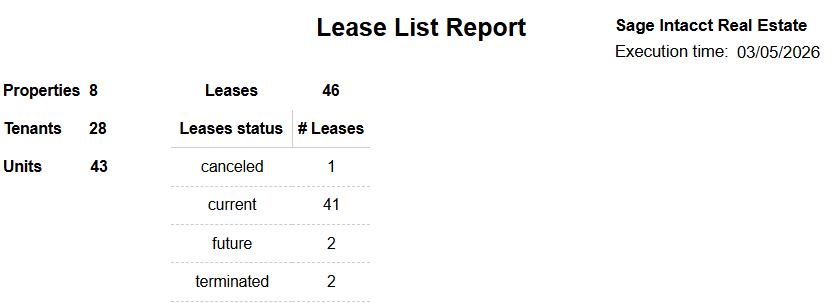
Lease List Report title
-
Execution date indicating when the report was generated
Step 4 - Review the Summary Metrics
The report includes summary tiles that provide portfolio-level counts based on the selected filters.
These summary metrics include:
-
Properties
-
Tenants
-
Units
The report also includes summary blocks by lease status:
-
Leases status
-
# Leases (number of leases per stauts)
Step 5 - Review the Detail Table
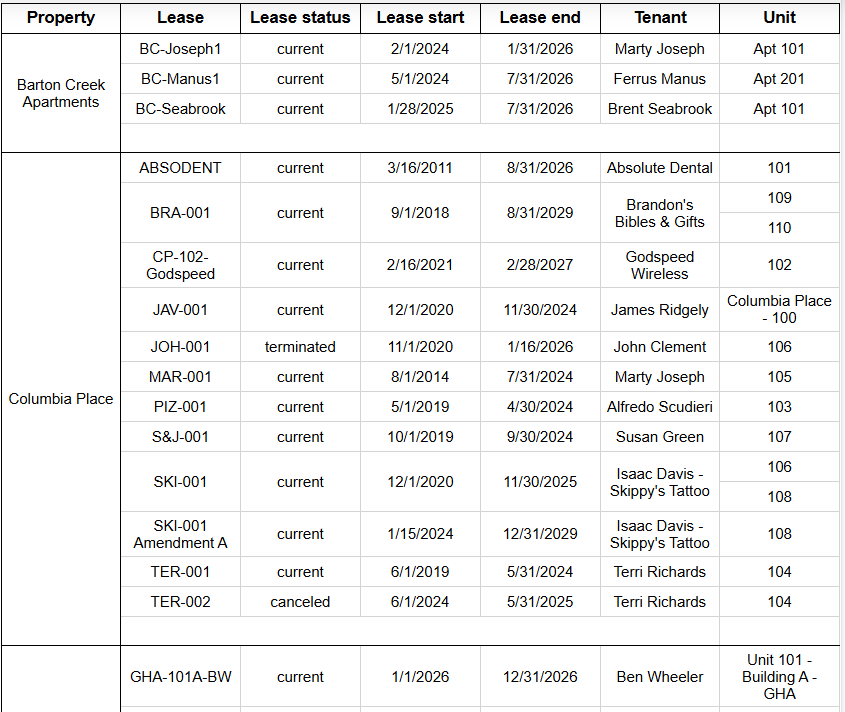
The detailed section of the report is grouped and displays the following columns:
-
Property
-
Lease
-
Lease Status
-
Lease Start
-
Lease End
-
Tenant
-
Unit
Expected Display
-
Summary counts update dynamically based on the selected filters
-
Detail rows are grouped by Lease Status and Property
-
Date columns show the lease start and end dates for each record
3. Technical Explanation
Filter Behavior
This report applies user-driven filtering using the following parameters:
-
Entity ID
-
Property Name
-
Lease Status
The Lease Status parameter also drives the grouping and summary sections used in the report layout.
Table Structure
The report is divided into two functional sections.
Summary Section
The summary section displays high-level metrics including counts of:
-
properties
-
tenants
-
units
-
leases and leases by status
Detail Section
The detail section contains the grouped lease records.
The hierarchy allows users to navigate from:
-
property grouping
to -
individual lease records
Granularity Explanation
The report maintains lease-level granularity while preserving grouping context.
This structure allows users to:
-
quickly evaluate trends by lease status
-
review individual lease records
-
understand overall portfolio composition through summary metrics
4. Troubleshooting
No Data Returned
Possible causes:
-
Selected filters are too restrictive
-
No leases match the selected property and lease status combination
Possible fixes:
-
Add additional Property Name selections
-
Broaden the Lease Status filter
-
Verify the Entity ID selection
Summary Counts Seem Lower Than Expected
Possible causes:
-
Summary counts reflect only records that match the current filter selections
Possible fixes:
-
Review the selected filter values
-
Temporarily broaden filters and compare results
Missing Expected Lease in Detail Section
Possible causes:
-
The lease status is not included in the selected values
-
The property selection excludes the lease
Possible fixes:
-
Include additional Lease Status values
-
Add the relevant properties and rerun the report
Limited Filter Values
Possible causes:
-
Available filter values depend on the current environment context
Possible fixes:
-
Select Entity ID first
-
Re-open Property Name and Lease Status filters after updating the entity selection
-
Confirm the relevant records are active in your environment
5. Customization
Common enhancement requests for this report include the following.
Field and Layout Customization
-
Add or remove columns in the detail section
-
Rename column headers to match client terminology
-
Reorder detail columns
Summary Enhancements
-
Add additional KPI tiles
-
Add new status-level metrics
-
Add trend views by reporting period
Filter and Grouping Changes
-
Add new report filters
-
Change the grouping sequence
-
Adjust default filter behavior
These modifications can be requested as a report customization through the customer portal.